



 Category view
2026 – Q2
Link Copied
Published on Apr 18, 2026
These release notes provide an overview of the new, comprehensive release that is now available on the UAT environment. Among other things, we are introducing advanced view options for operational modules, a powerful new import function, and extensive GDPR rules. Additionally, the user experience surrounding reservations, communication, and ticketing has been further refined.
Operational views & data
New views for operational modules
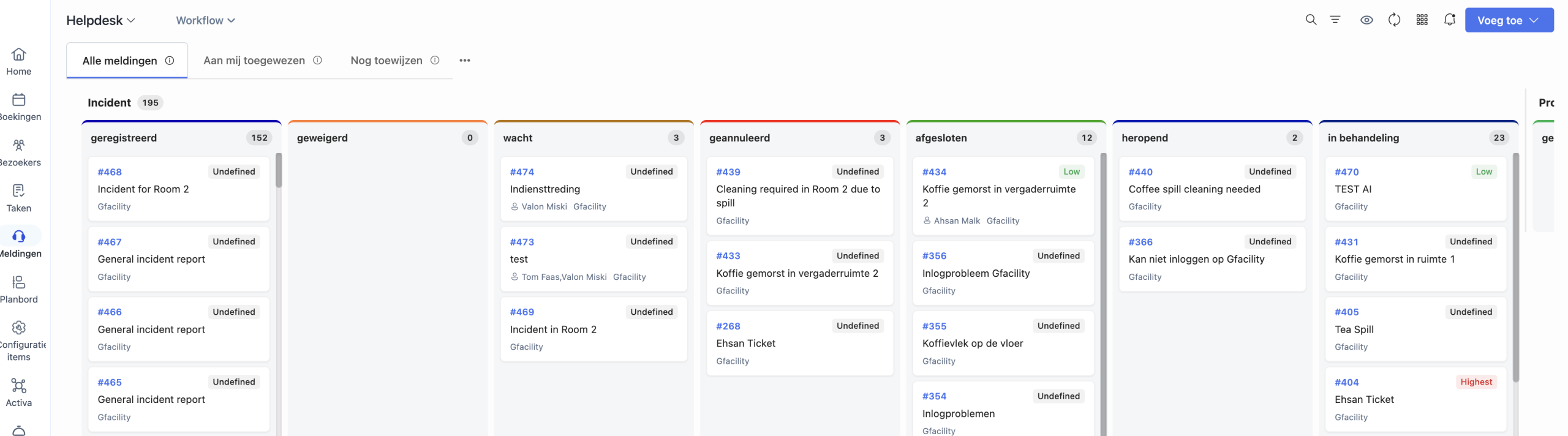
In the Ticketing, Tasks, Reservations, Visitors, CI, Assets, Products, and Knowledge Base modules, you can now choose powerful new views in addition to the standard list to make your work faster and more insightful.
-
Tree view
Hierarchical view with customizable underlying items (note: only available for tickets and reservations). -
Kanban
Visual workflow overview in columns (note: not available for reservations). -
Scheduler
Timeline for effective capacity and planning management. -
Pivot
Pivot tables for lightning-fast data analysis.
A display maximum of 500 records applies to the Tree view, Kanban, and Pivot views. Does your filter or view contain more than 500 records? Then these specific view options will be temporarily unavailable until the list is narrowed down using filters.
Bulk data import
From now on, you can easily import data in bulk, which makes setting up and updating your environment much faster.
- Supported modules: Available for CIs, Assets, and Knowledge Articles.
- Limit: You can import or modify up to a maximum of 5,000 objects at a time.
- Permissions required: This functionality is exclusively available to users who already have ‘bulk edit’ permissions.
Ticketing, tasks & reservations
Improvements for tickets
- Child tickets and automatic closure: It is now possible to link child tickets to a major ticket. When the major ticket is closed, underlying child tickets can be automatically archived along with it. The status of the child ticket is synchronized with the status class of the major (e.g., class ‘Completed’).
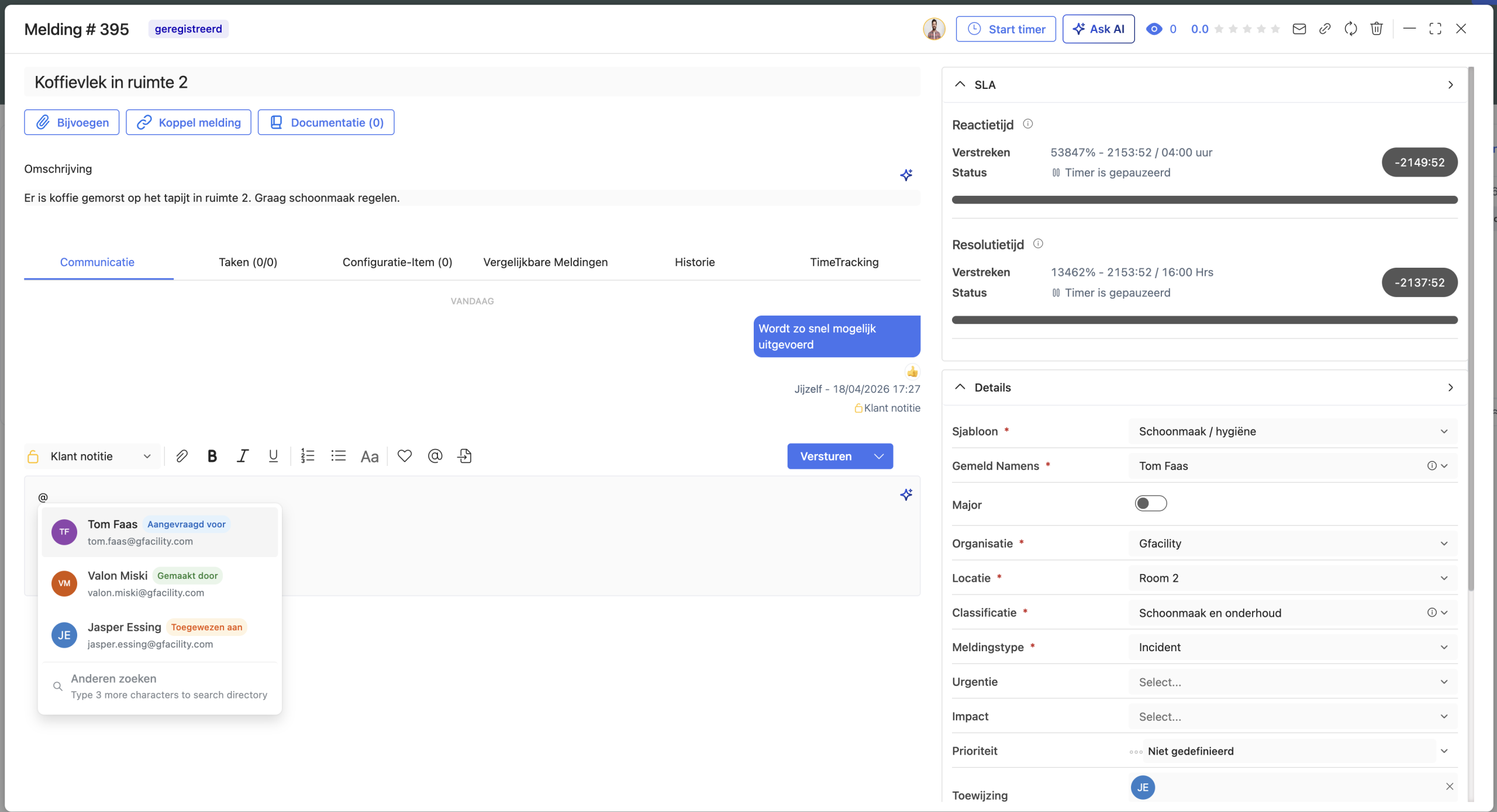
- Conversation synchronization: Messages and conversations added to a major ticket can now optionally be automatically shared with all linked child records.
- Tag functionality: From now on, you can easily add tags to tickets to categorize them better and find them faster.
- Real-time presence indicator: See instantly who has a specific ticket open at that moment, preventing duplicate work on the same ticket.
- Status changes via bulk-edit: You can now change the status of multiple tickets in bulk. Note: a new status is only shown as an option if it is an allowed next step for all selected tickets.
We have further expanded and structured our automation capabilities:
- Task rules relocated: Task rules have been moved from Tasks to Rules under Automations, ensuring that all automation logic is managed centrally.
- New time-based triggers: Added for Tickets and Tasks: a trigger based on the modified date/time. This allows you to automatically execute actions when no changes occur for a specific amount of time (e.g., automatically change the status upon inactivity).
-
New workflow classes (statuses): New classes have been added to better structure and report on processes: Wait for customer, Wait for supplier, Replied, and Archived. These classes are available for use in automation and reporting.
- Important: For existing customers, no new statuses are automatically created, and existing workflows remain unchanged. If you would like to use these classes in existing workflows, they can be added upon request. For new workflows, they are included by default.
- Archived behavior: When a ticket is set to Archived, it becomes completely read-only. Modifications are no longer possible. Only status changes remain possible according to the configured workflow rules.
- Conversation-based triggers: A new trigger, conversation added, has been introduced. This includes a condition for “by whom” (e.g., created by, requester, assigned to), allowing you to automate actions based on exactly who responds.
These improvements make it possible to automate workflows more intelligently and gain better insight into statuses and turnaround times.
Time tracking and GDPR rules
You now have more control over your hours and privacy-sensitive data within tickets and tasks.
-
Time tracking: It is now possible to log worked time. This can be done manually afterwards, or automatically via the start counter that starts running as soon as you begin working.
Note: new permissions have been created in the system for this, which are disabled by default and must be activated by administrators. - Extensive GDPR rules: It is possible to schedule data within tickets and tasks to be automatically deleted or anonymized at a set time.
Improvements for reservations
- Revamped reservation form: The UX of the forms has been significantly improved, and usage has been simplified.
- Room information instantly visible: In the list view, the description of the room and the available features (facilities) are now immediately displayed, allowing you to make the right choice faster.
- Location requirement for products: When you want to add a product directly to your reservation, the system will now first notify you that a location must be selected.
-
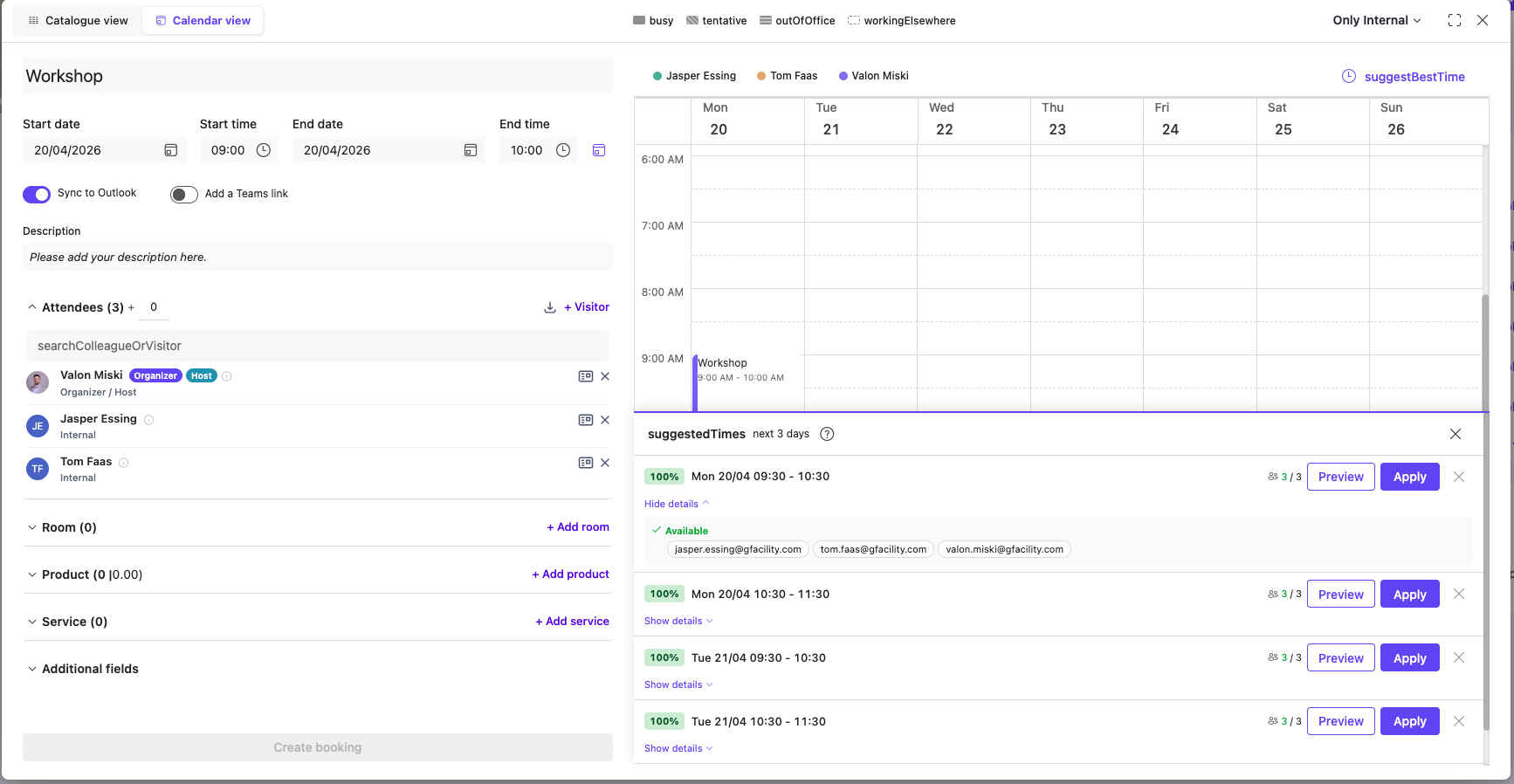
Insight into availability & smart suggestions: While making a reservation, you now have the option to consult the calendar view directly. You can also use smart suggestions to quickly find an ideal time slot.
💡 How does this suggestion work?
The system calculates the ideal moment based on a few smart rules:
- Roles & status: Organizers weigh the most, followed by mandatory and optional attendees. A ‘free’ calendar scores positively, while ‘Out of office’ immediately excludes a proposed moment.
- Working hours: Slots that overlap with lunch or fall outside standard office hours are automatically ignored.
- Result: You will always see the moments with the highest score (and therefore the best availability). In case of a tie, the earliest time is recommended.
Locations & visitors
Kiosk and room signages
Both the interaction with visitors and the registration of locations have been optimized with new features for our hardware and kiosk solutions.
- Customizable registration fields (kiosk): You now have full control over the registration process. You can configure yourself which input fields are active for visitors and which of them must be filled in as mandatory.
- Visitor check-out (kiosk): A new option has been made available allowing visitors to now check themselves out via the Kiosk when they leave.
- Accept terms and conditions (kiosk): During the registration process, you can now require visitors to agree to terms and conditions, such as safety regulations or privacy rules.
- Location registration (room signages): From now on, we accurately track exactly which specific Room Signage was used to check in or out, providing real-time insight into the exact location.
Because we are transitioning to a new infrastructure, the communication protocol between the devices and Gfacility is changing. This means that all Kiosks and Room Signages must be reactivated after the migration to continue communicating with the software. Please schedule this reactivation to prevent screen downtime.
Authentication & security
New login method with MFA
We have added the option to log in with a username and password, additionally secured by MFA (Multi-Factor Authentication). Users can now directly reset their passwords themselves via email.
To avoid disrupting current workflows, this new login option is disabled by default for existing customers. As a result, it is not yet directly possible to log in the new way; the process for you still proceeds as usual via Sign in with Microsoft or your own SSO.
Configuration & templates
This change has a direct impact on how you configure templates. The old method where you could choose between ‘allowed values’ or ‘default’ when adding a CI in a template has been deprecated.
New mandatory workflow: From now on, you must always select a public filter. When adding a CI, you can only choose values that are permitted by this filter. The columns defined in this public filter are now also automatically inherited for both displaying and adding data.
Performance & infrastructure
We have decided to merge the planned technical migration from App Engine to Cloud Run with this release. As a result, you will directly benefit from a renewed, more powerful environment. Thanks to this transition, the platform will run significantly more performant and stable. In addition, we have implemented targeted optimizations that strongly improve the overall speed of the application.
- Noticeably faster: You will instantly experience that loading and opening views, the homepage, and individual records is much smoother. Everything feels more responsive, ensuring a more efficient and pleasant working experience.
General improvements & communication
Various quality improvements across the board to make mutual communication and system navigation smoother.
-
Send emails manually: In addition to automatic emails, you now also have the option to manually send an email at any time, with full control over the content.
Note: a new permission has been created for this, which is disabled by default and must be activated by administrators. - Workflow visualization: You can now make workflows visually insightful. When selecting a status, you immediately see the possible next steps and who has the permissions to execute them.
- Cloning settings: You can easily clone groups, SLAs, and filters to create new configurations at lightning speed.
- New Rich-text formatting & Communication: A new rich-text editor is available with extensive formatting options. In addition, you now have the ability to reset the layout (very handy for pasted text). Furthermore, the communication field for tasks has been significantly enlarged, and there is support for emojis in messages.
- Liking messages & Emoji reactions: It is now possible to like messages and react with emojis. A new trigger has also been added to the notification rules for this (Other -> Emoji added). A template is available for this notification; let us know if you are interested, and we will add it to your environment.
- Smarter @-mentions & search: When tagging people, you immediately get suggestions of active roles within the object. The general search function now perfectly supports spaces and allows you to seamlessly search by first name, last name, and email.
-
Notifications & ratings: Receive a direct email copy of your own written messages. Moreover, you can navigate directly to forms and reviews via email thanks to the new
?rating=truelink. - Profile view for user lookups: For all user lookups and profiles, we now instantly display the initials by default, or the profile picture if one is provided. Deleting your profile picture is now also easily possible.
- New indication for saving overviews (views): When modifying an overview, a blue bar no longer appears at the top of the screen. Instead, you now see a subtle blue dot directly inside your overview. By clicking on this dot, or on the info button of the view, you immediately get the option to save the modified view.
- Optimized rating display: To save screen space and keep the overview cleaner, the rating display on objects has been shortened. Instead of 5 separate buttons (stars), only 1 star is now shown.
🔌 API changes — operational modules
All operational GET endpoints (Configuration Items, Assets, Knowledge Base, Products, Services) have been revised. Key changes:
For all modules:
-
New parameter
view_type(flat | tree | timeline | pivot | kanban)
Determines which column set andstateDatakey is returned. Default =columns. Send explicitview_type=flatfor identical behavior to today. -
Custom field type
configuration_item_lookupno longer returns the nestedconfigurationItem:{id,title}object — clients must fetch this themselves. - Error messages (i18n): Error messages are now translated. Clients that parse for exact English error strings must switch to error codes.
-
New attachment support:
.numbersfiles (Apple Numbers) are now allowed as an attachment.
Per module:
-
Configuration Items: relations endpoint
/relationbecomes/relations. New alias isGET /configuration-item/list. The index method has been optimized for performance. Relations also automatically create reverse relations (with cycle detection). -
Assets: the field
customColumnshas been removed from the list response. -
Tickets & Events:
view_typenow additionally determines the nesting of child records and tasks (kanban/timeline/tree). If aview_typeis missing, the server temporarily falls back totreewith tasks nested — send explicitview_type=flatto retain the old flat response. -
Limit Tickets & Events: for
kanban/timeline/tree, thetakelimit is capped at 500.