


As IT environments become more complex, organisations are re-evaluating whether their existing IT service management tools still meet modern operational needs. While Jira Service Management and ServiceNow remain popular choices, a growing number of companies are now choosing Gfacility as a more practical, agile, and cost-effective alternative.
This shift is not about replacing tools blindly. It’s about finding an ITSM platform that delivers real outcomes, faster adoption, and measurable value without unnecessary complexity.
Here are the top 10 reasons businesses are choosing Gfacility over Jira and ServiceNow.
1. Faster implementation with less operational friction
ServiceNow implementations often take months and require heavy configuration, consultants, and change management. Jira, while quicker, still demands significant customisation to function as a full ITSM platform.
Gfacility is designed for rapid deployment, allowing teams to go live in weeks rather than quarters. Pre-configured ITIL-aligned workflows reduce setup time and eliminate over-engineering.
Why it matters: Faster go-live means faster ROI.
2. Built for IT teams, not just developers or enterprises
Jira originated as a development and issue-tracking tool. ServiceNow was built primarily for large enterprises with complex governance structures.
Gfacility is purpose-built for modern IT operations teams that need clarity, control, and automation without enterprise bloat or developer dependency.
Why it matters: IT teams stay productive without relying on engineers or external admins.
3. AI that delivers outcomes, not just features
Both Jira and ServiceNow promote AI capabilities, but in many cases these features are add-ons or limited to specific modules.
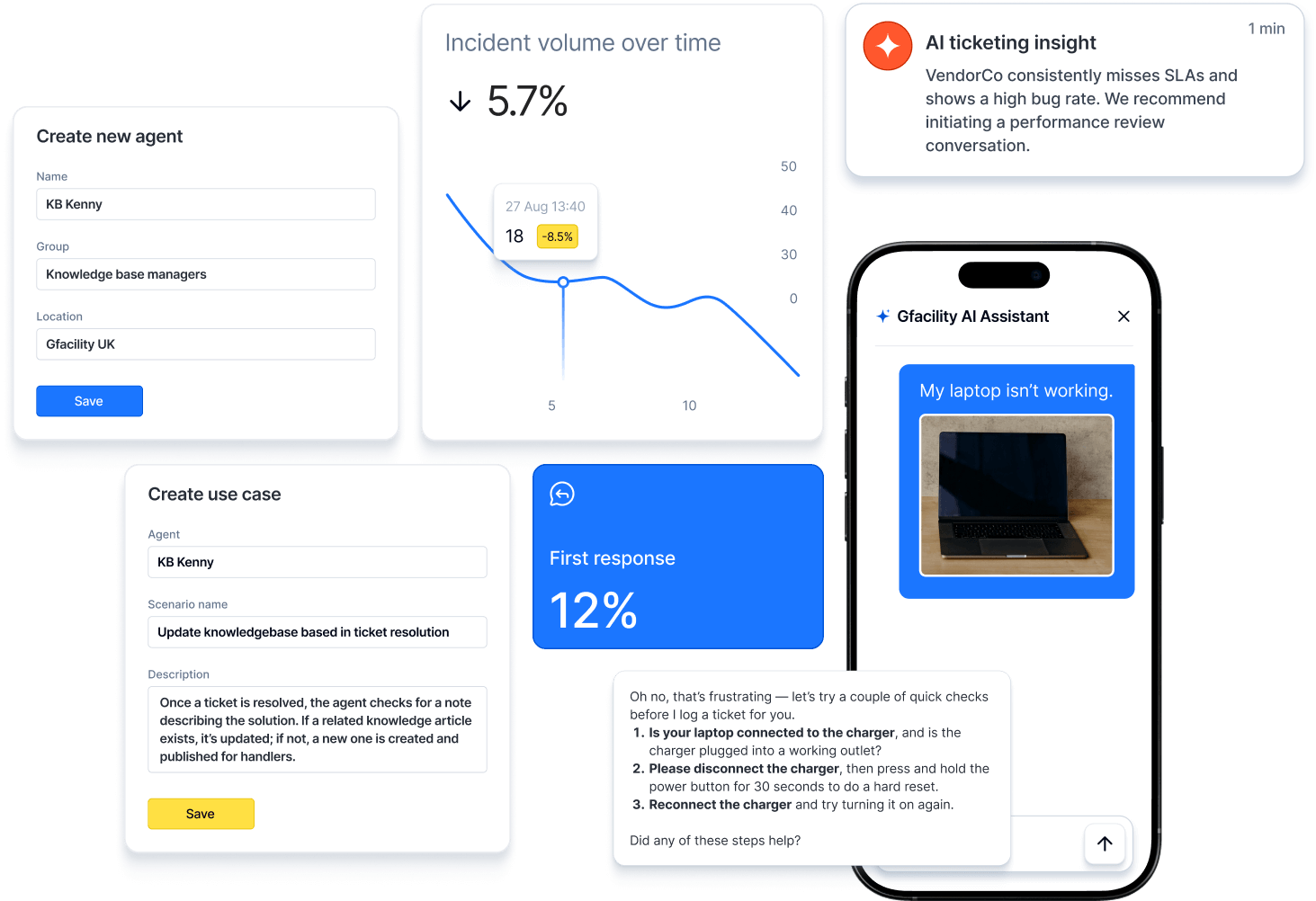
Gfacility embeds AI across the service lifecycle, enabling:
- Intelligent ticket classification
- Smart routing and prioritisation
- Predictive risk identification
- Actionable insights instead of static reports
Why it matters: AI reduces workload instead of adding another layer to manage.
4. Simpler user experience for agents and end users
ServiceNow is powerful but often overwhelming for non-technical users. Jira’s interface works well for developers but can feel unintuitive for business users.
Gfacility prioritises clean design and usability, allowing:
- Faster ticket submission
- Easier navigation
- Reduced training time
- Higher adoption across departments
Why it matters: Tools only work when people actually use them.
5. Unified ITSM without marketplace dependency
Jira relies heavily on third-party plugins for asset management, change workflows, reporting, and automation. ServiceNow often requires additional licensed modules.
Gfacility delivers core ITSM capabilities out of the box, including:
- Incident, problem, and change management
- Asset and configuration visibility
- SLA tracking
- Workflow automation
- Analytics and dashboards
Why it matters: Fewer integrations mean fewer failures and lower maintenance costs.
6. Cost transparency and predictable pricing
ServiceNow is known for high licensing costs and unpredictable expansion fees. Jira can become expensive once plugins, automation, and asset tools are added.
Gfacility offers clear, scalable pricing without hidden dependencies or mandatory add-ons.
Why it matters: IT leaders can plan budgets without surprises.
7. Better alignment with ITIL best practices
While both Jira and ServiceNow support ITIL frameworks, Jira often requires heavy configuration to align properly.
Gfacility is ITIL-aligned by design, ensuring structured workflows, governance, and compliance without excessive customisation.
Why it matters: Standardisation improves consistency, audit readiness, and service quality.
8. Stronger focus on operational visibility
Many teams using Jira or ServiceNow report having data but lacking clarity.
Gfacility transforms operational data into real-time insights, giving IT leaders visibility into:
- Service performance
- Bottlenecks
- SLA risks
- Asset health
- Change impact
Why it matters: Better visibility leads to better decisions.
9. Scales without adding complexity
As organisations grow, Jira setups often become fragmented and difficult to manage. ServiceNow scales well but at the cost of complexity and administration overhead.
Gfacility scales horizontally and vertically, supporting growth while keeping workflows manageable and easy to adapt.
Why it matters: Growth should not slow down IT operations.
10. Designed for today’s hybrid and AI-driven workplaces
Modern IT environments include cloud systems, remote teams, automation, and constant change. Many legacy ITSM tools were not designed for this reality.
Gfacility supports:
- Hybrid and remote work models
- Cross-functional service delivery
- AI-driven operations
- Continuous improvement cycles
Why it matters: ITSM must evolve with how organisations actually work today.
Final thoughts
Jira and ServiceNow remain strong platforms in their own right. However, for companies seeking speed, simplicity, intelligence, and value, Gfacility offers a modern alternative that aligns better with real operational needs.
The move towards Gfacility is not about replacing tools it’s about reducing friction, improving outcomes, and enabling IT teams to focus on what truly matters.
FAQ
Why are companies switching from Jira to Gfacility?
Because Gfacility provides complete ITSM capabilities without relying on plugins or developer-centric workflows.
Is Gfacility a replacement for ServiceNow?
For many organisations, yes especially those seeking faster implementation, lower cost, and simpler operations.
Does Gfacility support enterprise IT operations?
Yes, while remaining flexible enough for mid-sized and growing organisations.